ANDALUCIA
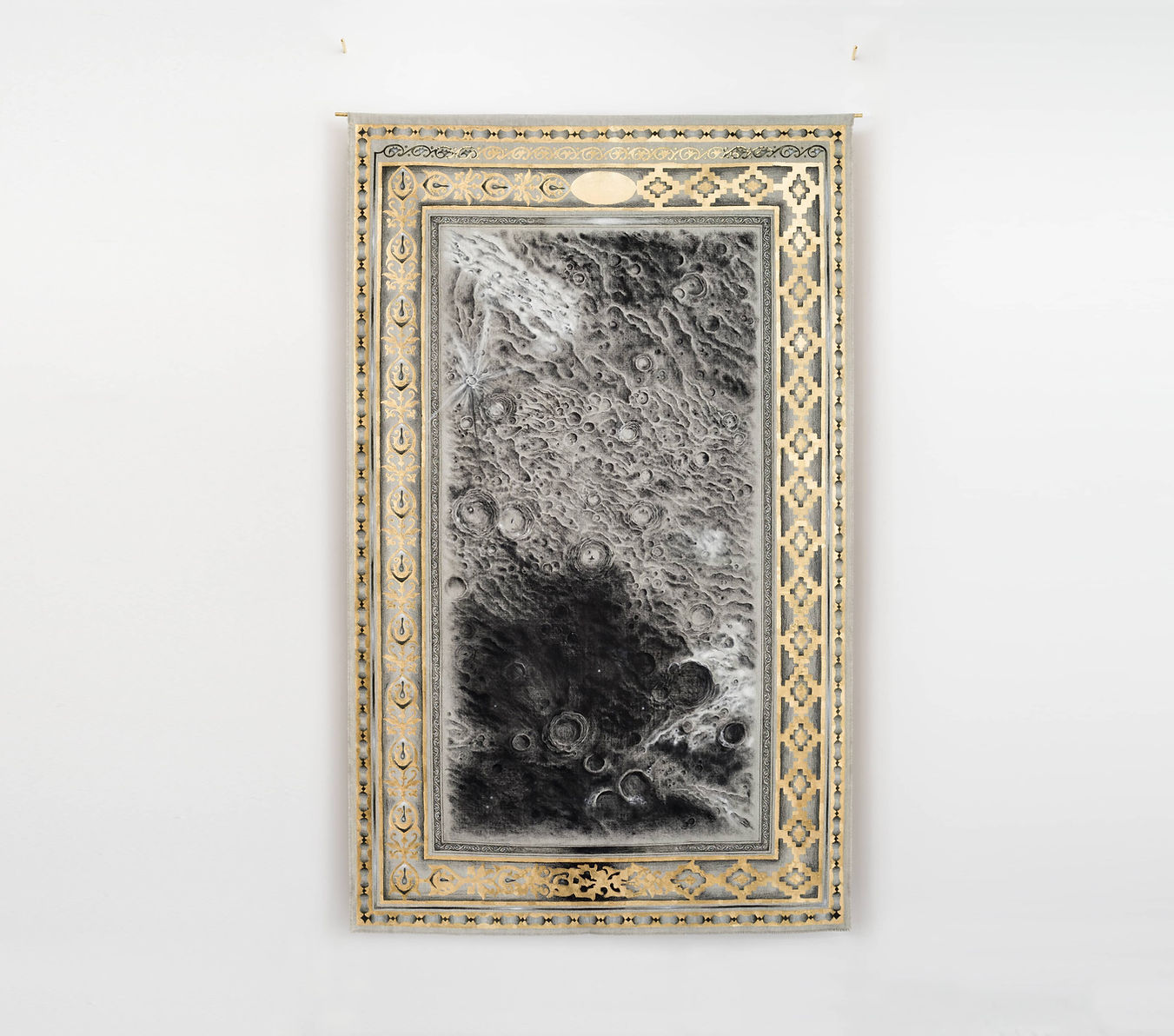
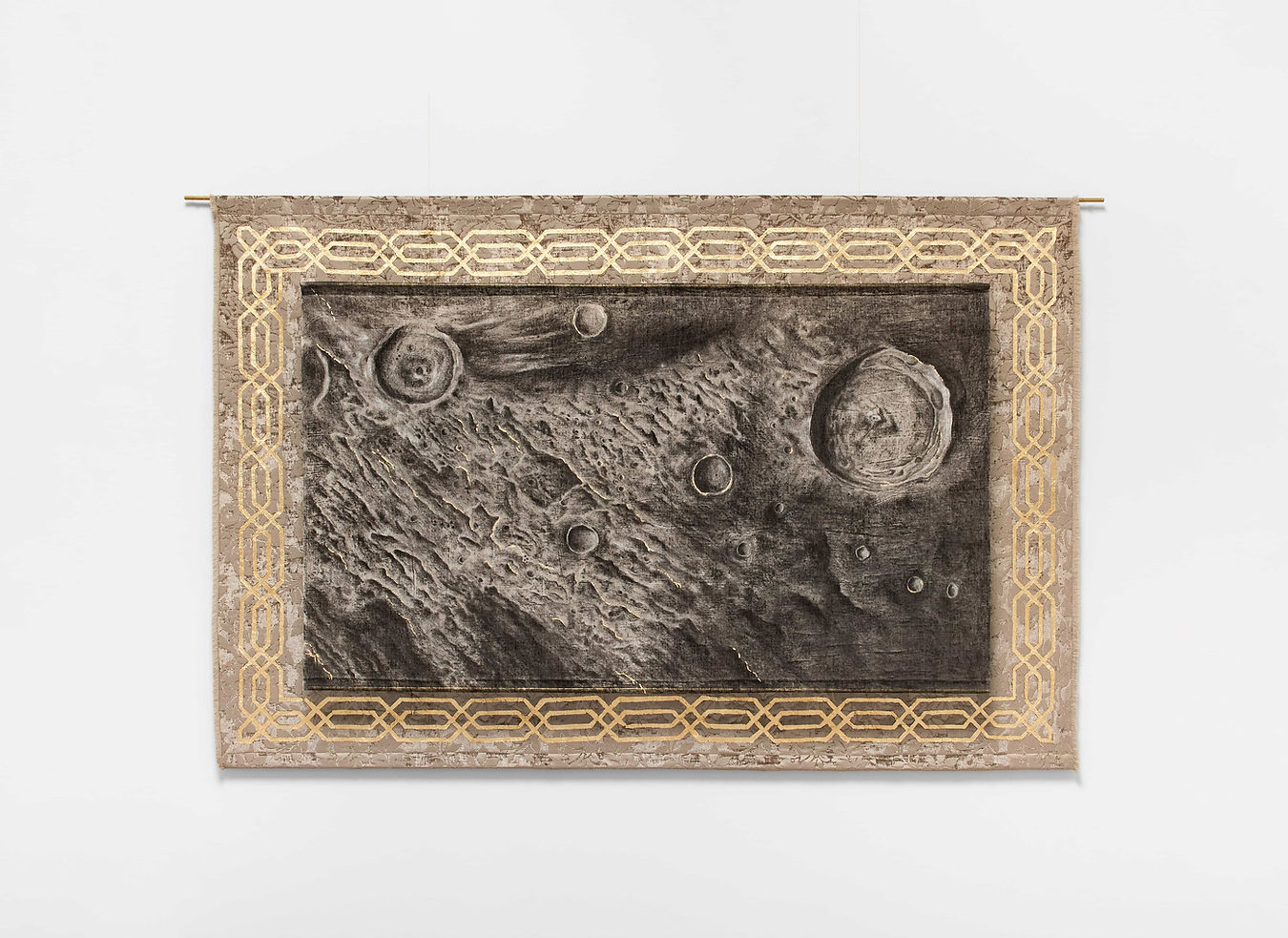
In the series Andalucía, Estrada revisits and deepens her gesture of bringing celestial nomenclature into proximity with the colonial toponymy of the Americas. In these six drawings in charcoal and metal leaf on linen, the artist brings together lunar cartography and the narratives surrounding the founding of Córdoba, in central-western Argentina, where she was born. Founded as Córdoba de la Nueva Andalucía, the city’s name was offered as both conjugal promise and remembrance of another land by its founder, the Spanish colonizer Jerónimo Luis de Cabrera. The settler repeated what he already knew, claiming that in Córdoba the people would be “tall and dark, like in Andalusia.” The city thus inaugurates itself under the sign of transfer and analogy, as an attempt to duplicate one territory onto another.
The observational drawings of the craters Arzachel, Ibn Rushd, Alpetragius, Al-Bakri, Ibn Firnas, and Geber, named in homage to astronomers of Al-Andalus, echo the selenographic gesture that baptized them: inscribing belonging to one place through reference to another. The craters are paired with gold and silver leaf frames bearing Alhambra patterns, Islamic ornamental geometry, and guardas Pampa, motifs associated with Indigenous cultures that were appropriated in the construction of the Argentine national imaginary.
In some works in the series, these ornamental systems draw close; in others, they remain juxtaposed without merging, like languages that share a territory without ever fully coinciding.
The friction between these visualities reveals how symbols from distinct traditions can be mobilized to order a space, whether peninsular, Latin American, or lunar. The network Estrada weaves between lunar toponyms and gestures of national formation suggests that the occupation of celestial and terrestrial space may be symbolic even before any arrival: structured by disputes, desires for sovereignty, and acts of colonial imagination.
By encircling the craters with these motifs, Estrada makes the historical gesture of naming and domination appear as a visible border. The sheen of the metal leaf interrupts the continuity of the lunar surface and reveals its overlapping eras, crossed by negotiations and projects of power external to it. Between the opacity of charcoal and the shimmer of metal, the image shifts: the lunar surface becomes a field of historical and symbolic inscription, where marks and projections sediment over time. These craters, like Córdoba, assert themselves as territories of projection, horizons extended from the same Andalusian prism.
.jpg)
.jpg)
.jpg)
.jpg)
.jpg)
.jpg)
.jpg)
.jpg)
.jpg)
.jpg)
.jpg)